domingo, 29 de junho de 2025

Jeanne Saulier, née Marie Jeanne Sauclière, le 24 juillet 1865, à Audenge et morte le 20 octobre 1940, est une comédienne et chanteuse d'opérettes française.


Actor

FrenchBorn Marie Jeanne Ernestine Eugénie Sauclière

French actress

Born on July 24, 1865 in Audenge, Gironde , France

Died on October 20, 1940 in Urt, Pyrénées-Atlantiques , France 

Filha de Ernest Eugène SAUCLIÈRE Jeanne Alice BÉZIAN 

page 216

 aqui o LINK

está dito que é de 1860 mas não poderia pela data das pessoas envolvidas.

Muito simples a pessoa por que a edição vai de 1000 a 1900 .

A data mais provável é 1900 ou 1910 pela data das pessoas envolvidas, das Mademoiselles dançarinas, e cantoras.


https://bdh-rd.bne.es/viewer.vm?id=0000052804 

https://bdh.bne.es/bnesearch/detalle/bdh0000052804
https://bdh-rd.bne.es/viewer.vm?id=0000052804


[Colección de etiquetas de cajas de cerillas. Miscelánea 7] [Material gráfico]
Autor
Planas, Eusebio (1833-1897)
Picó, P. (s. XIX-XX)
Sarovy, Damián (s. XIX-XX)
C. Taulet (San Sebastián)
J. Thomas (Barcelona)
Samsot y Missé, Hnos. (Barcelona)
E. Martin (Marseille)
Datos de edición
[San Sebastián; Barcelona; Marseille; etc. : C. Taulet, etc.
Tipo de Documento
Dibujos, grabados y fotografías
Descripción física
3.534 estampas y lám. sobre papel : cromolitografía, reproducción fotomecánica; 115 x 85 mm. o menos
Signatura
EPH/81(1)-EPH/81(3534)
PID
bdh0000052804
Resumen
Hay gran variedad iconográfica: tipos populares (españoles, franceses, italianos); marcas de fábricas españolas y extranjeras; caricaturas político-satíricas; retratos y biografía de personajes; pasatiempos (acertijos, jeroglíficos, siluetas, rompecabezas, ); escenas de deportes; moda; ilustración fosforera (fabricación de cajas de cerillas); escenas de circo, teatro y baile; escenas de amor; escenas de toros; modos de...(pedir, encender el cigarro); tipos de...(bigotes, sombreros, corbatas, cuellos); barcos; escudos; publicidad de baños. Hay algunas series incompletas: "El cronómetro del amor", Las ciruelas claudias", "El amor a la moda", "Los pecados capitales", "Los amantes", "El reino animal madrileño", "Fantasías nasales", "Baños de mar". Las marcas de fábrica y nombres de fabricantes aparecen de forma destacada sobre las ilustraciones (medallas y premios recibidos, vistas de ciudades, paisajes, figuras de mujeres, hombres o niños, globos aerostáticos, etc.). Las cajas que corresponden a los álbumes biográficos editados por la Compañía de Fósforos y Cerillas son series de retratos y su biografía, salvo las series con reproducciones de obras artísticas o las que recogen hechos históricos
Contenido
(1-2116): etiquetas sueltas, sin orden y con gran variedad iconográfica (2117-2196): Álbum biográfico para coleccionarlas. Serie Extraordinaria. Algo sobre El Quijote (2197-2236): Álbum biográfico para coleccionarlas. Serie 21. Grandes favoritas (2237-2311): Álbum biográfico para coleccionarlas. Serie 24. Grandes filósofos (2312-2386): Álbum biográfico para coleccionarlas. Serie 25. Princesas y grandes damas (2387-2451): Álbum biográfico para coleccionarlas. Serie 26. Grandes músicos (2452-2526): Álbum biográfico para coleccionarlas. Serie 27. Célebres poetisas y grandes escritoras (2527-2601): Álbum biográfico para coleccionarlas. Serie 28. Músicos contemporáneos (2602-2676): Álbum biográfico para coleccionarlas. Serie 29. Los Caprichos. Aguafuertes de Goya (2677-2756): Álbum biográfico para coleccionarlas. Serie 30. Cuadros célebres y sus autores (2757-2816): Álbum biográfico para coleccionarlas. Serie 31. Conmemorativa al Centenario de los Sitios (2817-2891): Álbum biográfico para coleccionarlas. Serie 32. [Papa, reyes, emperadores, ... de todo el mundo] (2892-2966): Álbum biográfico para coleccionarlas. Serie 33. [Reinas, infantas, princesas, ... de casas reales de Europa] (2967-3037): Álbum biográfico para coleccionarlas. Serie 1. [Retratos de mujeres] (3038-3109): Álbum biográfico para coleccionarlas. Serie 2. [Retratos de mujeres] (3110-3172): Álbum biográfico para coleccionarlas. Serie 3. [Retratos de mujeres] (3173-3225): Álbum biográfico para coleccionarlas. Serie 4. [Retratos de mujeres] (3226-3292): Álbum biográfico para coleccionarlas. Serie 5. [Retratos de mujeres] (3293-3342): Álbum biográfico para coleccionarlas. Serie 6. [Retratos de mujeres] (3343-3357): Álbum biográfico para coleccionarlas. Serie 7. [Retratos de mujeres] (3358-3379): Álbum biográfico para coleccionarlas. Serie 8. [Retratos de mujeres] (3380-3453): Álbum biográfico para coleccionarlas. Serie 9. [Reyes, príncipes, emperadores...de España y Europa] (3454-3534): Álbum biográfico para coleccionarlas. Serie A. Museo Nacional (2817-2891): Álbum biográfico para coleccionarlas. Serie 32. [Papa, reyes, emperadores,... de todo el mundo] (2892-2966): Álbum biográfico para coleccionarlas. Serie 33. [Reinas, infantas, princesas,... de casas reales de Europa]
Descripción y notas
Sobre las imágenes están impresos los nombres de las fábricas y fabricantes, ilustradores, talleres, características del producto y si son "Proveedores de la Real Casa". En los álbumes de fototipias el retrato del personaje va acompañado de una pequeña biografía
Biblioteca Nacional. Ephemera, p. 154, 155
Aunque la colección está formada por tres mil quinientas treinta y cuatro cajas de cerillas, hay que tener en cuenta que hay diecisiete saltos en la numeración (1773 -1787, 1802, 1849 -1851), catorce sin numerar y falta una ilustración (8)
No aparecen fechas pero la mayor parte de la colección pertenece a un período de tiempo entre 1870 y 1920
En la parte inferior de muchas cajas de cerillas aparecen las inicales o la firma de los principales ilustradores: G.B., L. Genovés, Eusebio Planas, T.R., A. Rieux, Ch. Taulet, etc. Los ilustradores Luis Moreno, P. Moreno, Damián Sarovy, Phil May, P. Picó, J. Pérez, O'Nerom, R. de Terán, etc. son los autores de las litografías de las láminas -soporte de algunas series de fototipias. En total son treinta y un ilustradores
De los doce talleres de impresión destacan los siguientes: C. Taulet y Lith. E. Jornet (San Sebastián), J. Thomas y Samsot y M. Hermanos (Barcelona), E. Martin (Marseille), Cayer & Cie (sin lugar), etc.
Unos pliegos de dos hojas hacen de soporte para las cajas de cerillas. La mayor parte de las hojas tienen impresos nueve marcos rectangulares donde van colocadas las cajas pero hay algunas hojas con seis, ocho e incluso treinta cajas. Las series de fototipias de cajas de cerillas 1 a 9, 21, 24 a 33, la serie A y la serie extraordinaria están pegadas en los álbumes biográficos o en láminas sueltas litografiadas editadas por la Compañía de Fósforos y Cerillas 


https://www.cambridge.org/core/journals/dance-research-journal/article/is-mademoiselle-mercedes-always-julienne-mathieu-the-challenges-of-using-a-stage-name-to-reconstruct-the-career-of-a-parisian-belle-epoque-music-hall-dancer/B359705B6F8B89FF80CB4269BFF3FBD8 

https://archive.li/WutUR 

https://fr.wikipedia.org/wiki/Jeanne_Saulier 

https://en.geneastar.org/genealogy/sauclierema/jeanne-saulier 

https://gw.geneanet.org/geneavendeemili?n=bezian&oc=0&p=jeanne+alice&type=tree 

https://gw.geneanet.org/geneavendeemili?n=bezian&oc=0&p=jeanne+alice&type=tree 

https://archive.li/RdDVc 

https://archive.li/k1Cnk 

 Click on any field below to edit it
Page Title *Jeanne Saulier, Née Marie Jeanne Sauclière,
Page URL * https://archive.org/details/jeanne-saulier-nee-marie-jeanne-saucliere
Description * Jeanne Saulier, née Marie Jeanne Sauclière, le 24 juillet 1865 à Audenge[1] et morte le 20 octobre 1940 est une comédienne et chanteuse d'opérettes française. 

https://gallica.bnf.fr/ark:/12148/btv1b53279069j.r=Jeanne%20Saulier?rk=85837;2
https://gallica.bnf.fr/services/engine/search/sru?operation=searchRetrieve&version=1.2&query=%28gallica%20all%20%22Jeanne%20Saulier%22%29&lang=fr&suggest=0

 Titre :  Jeanne Saulier assise. 1892 : [photographie]
Date d'édition :  1892
Sujet :  Saulier, Jeanne (1865-1940)
Sujet :  Artistes lyriques -- Paris (France) -- 1870-1914
Sujet :  Portraits du théâtre -- 1870-1913
Notice du catalogue :  Notice de recueil : http://catalogue.bnf.fr/ark:/12148/cb47116340b
Relation :  Appartient à : [Recueil]. Théâtre. 1891-1893. 03, Portraits d'actrices, danseuses et artistes lyriques
Notice du catalogue :  http://catalogue.bnf.fr/ark:/12148/cb47449777n
Type :  image fixe
Type :  photographie
Langue  :  français
Format :  1 photogr. pos. sur papier albuminé : d'après...
Format :  image/jpeg
Format :  Nombre total de vues : 1
Description :  Portraits
Droits  :  Consultable en ligne
Identifiant :  ark:/12148/btv1b532790861
Source  :  Bibliothèque nationale de France, département Arts du spectacle, 4-ICO VAR-1 (3, 43)
Conservation numérique :  Bibliothèque nationale de France
Date de mise en ligne  :  14/07/2024 

Subject Tags * : Saulier, Jeanne (1865-1940) Sujet : Artistes lyriques -- Paris (France) -- 1870-1914 Sujet : Portraits du théâtre -- 1870-1913
Creator : Saulier, Jeanne (1865-1940) Sujet : Artistes lyriques -- Paris (France) -- 1870-1914 Sujet : Portraits du théâtre -- 1870-1913
Date 1913
Collection * Community image
Test Item No
Language French
License Public Domain


Geneviève Lantelme, nom de scène de Mathilde Hortense Claire Fossey, 20 mai 1883 18e arrondissement de Paris, 25 juillet 1911 (à 28 ans) Rhin


page 218

 aqui o LINK

está dito que é de 1860 mas não poderia pela data das pessoas envolvidas.

Muito simples a pessoa por que a edição vai de 1000 a 1900 .

A data mais provável é 1900 ou 1910 pela data das pessoas envolvidas, das Mademoiselles dançarinas, e cantoras.


https://bdh-rd.bne.es/viewer.vm?id=0000052804 

https://bdh.bne.es/bnesearch/detalle/bdh0000052804
https://bdh-rd.bne.es/viewer.vm?id=0000052804


[Colección de etiquetas de cajas de cerillas. Miscelánea 7] [Material gráfico]
Autor
Planas, Eusebio (1833-1897)
Picó, P. (s. XIX-XX)
Sarovy, Damián (s. XIX-XX)
C. Taulet (San Sebastián)
J. Thomas (Barcelona)
Samsot y Missé, Hnos. (Barcelona)
E. Martin (Marseille)
Datos de edición
[San Sebastián; Barcelona; Marseille; etc. : C. Taulet, etc.
Tipo de Documento
Dibujos, grabados y fotografías
Descripción física
3.534 estampas y lám. sobre papel : cromolitografía, reproducción fotomecánica; 115 x 85 mm. o menos
Signatura
EPH/81(1)-EPH/81(3534)
PID
bdh0000052804
Resumen
Hay gran variedad iconográfica: tipos populares (españoles, franceses, italianos); marcas de fábricas españolas y extranjeras; caricaturas político-satíricas; retratos y biografía de personajes; pasatiempos (acertijos, jeroglíficos, siluetas, rompecabezas, ); escenas de deportes; moda; ilustración fosforera (fabricación de cajas de cerillas); escenas de circo, teatro y baile; escenas de amor; escenas de toros; modos de...(pedir, encender el cigarro); tipos de...(bigotes, sombreros, corbatas, cuellos); barcos; escudos; publicidad de baños. Hay algunas series incompletas: "El cronómetro del amor", Las ciruelas claudias", "El amor a la moda", "Los pecados capitales", "Los amantes", "El reino animal madrileño", "Fantasías nasales", "Baños de mar". Las marcas de fábrica y nombres de fabricantes aparecen de forma destacada sobre las ilustraciones (medallas y premios recibidos, vistas de ciudades, paisajes, figuras de mujeres, hombres o niños, globos aerostáticos, etc.). Las cajas que corresponden a los álbumes biográficos editados por la Compañía de Fósforos y Cerillas son series de retratos y su biografía, salvo las series con reproducciones de obras artísticas o las que recogen hechos históricos
Contenido
(1-2116): etiquetas sueltas, sin orden y con gran variedad iconográfica (2117-2196): Álbum biográfico para coleccionarlas. Serie Extraordinaria. Algo sobre El Quijote (2197-2236): Álbum biográfico para coleccionarlas. Serie 21. Grandes favoritas (2237-2311): Álbum biográfico para coleccionarlas. Serie 24. Grandes filósofos (2312-2386): Álbum biográfico para coleccionarlas. Serie 25. Princesas y grandes damas (2387-2451): Álbum biográfico para coleccionarlas. Serie 26. Grandes músicos (2452-2526): Álbum biográfico para coleccionarlas. Serie 27. Célebres poetisas y grandes escritoras (2527-2601): Álbum biográfico para coleccionarlas. Serie 28. Músicos contemporáneos (2602-2676): Álbum biográfico para coleccionarlas. Serie 29. Los Caprichos. Aguafuertes de Goya (2677-2756): Álbum biográfico para coleccionarlas. Serie 30. Cuadros célebres y sus autores (2757-2816): Álbum biográfico para coleccionarlas. Serie 31. Conmemorativa al Centenario de los Sitios (2817-2891): Álbum biográfico para coleccionarlas. Serie 32. [Papa, reyes, emperadores, ... de todo el mundo] (2892-2966): Álbum biográfico para coleccionarlas. Serie 33. [Reinas, infantas, princesas, ... de casas reales de Europa] (2967-3037): Álbum biográfico para coleccionarlas. Serie 1. [Retratos de mujeres] (3038-3109): Álbum biográfico para coleccionarlas. Serie 2. [Retratos de mujeres] (3110-3172): Álbum biográfico para coleccionarlas. Serie 3. [Retratos de mujeres] (3173-3225): Álbum biográfico para coleccionarlas. Serie 4. [Retratos de mujeres] (3226-3292): Álbum biográfico para coleccionarlas. Serie 5. [Retratos de mujeres] (3293-3342): Álbum biográfico para coleccionarlas. Serie 6. [Retratos de mujeres] (3343-3357): Álbum biográfico para coleccionarlas. Serie 7. [Retratos de mujeres] (3358-3379): Álbum biográfico para coleccionarlas. Serie 8. [Retratos de mujeres] (3380-3453): Álbum biográfico para coleccionarlas. Serie 9. [Reyes, príncipes, emperadores...de España y Europa] (3454-3534): Álbum biográfico para coleccionarlas. Serie A. Museo Nacional (2817-2891): Álbum biográfico para coleccionarlas. Serie 32. [Papa, reyes, emperadores,... de todo el mundo] (2892-2966): Álbum biográfico para coleccionarlas. Serie 33. [Reinas, infantas, princesas,... de casas reales de Europa]
Descripción y notas
Sobre las imágenes están impresos los nombres de las fábricas y fabricantes, ilustradores, talleres, características del producto y si son "Proveedores de la Real Casa". En los álbumes de fototipias el retrato del personaje va acompañado de una pequeña biografía
Biblioteca Nacional. Ephemera, p. 154, 155
Aunque la colección está formada por tres mil quinientas treinta y cuatro cajas de cerillas, hay que tener en cuenta que hay diecisiete saltos en la numeración (1773 -1787, 1802, 1849 -1851), catorce sin numerar y falta una ilustración (8)
No aparecen fechas pero la mayor parte de la colección pertenece a un período de tiempo entre 1870 y 1920
En la parte inferior de muchas cajas de cerillas aparecen las inicales o la firma de los principales ilustradores: G.B., L. Genovés, Eusebio Planas, T.R., A. Rieux, Ch. Taulet, etc. Los ilustradores Luis Moreno, P. Moreno, Damián Sarovy, Phil May, P. Picó, J. Pérez, O'Nerom, R. de Terán, etc. son los autores de las litografías de las láminas -soporte de algunas series de fototipias. En total son treinta y un ilustradores
De los doce talleres de impresión destacan los siguientes: C. Taulet y Lith. E. Jornet (San Sebastián), J. Thomas y Samsot y M. Hermanos (Barcelona), E. Martin (Marseille), Cayer & Cie (sin lugar), etc.
Unos pliegos de dos hojas hacen de soporte para las cajas de cerillas. La mayor parte de las hojas tienen impresos nueve marcos rectangulares donde van colocadas las cajas pero hay algunas hojas con seis, ocho e incluso treinta cajas. Las series de fototipias de cajas de cerillas 1 a 9, 21, 24 a 33, la serie A y la serie extraordinaria están pegadas en los álbumes biográficos o en láminas sueltas litografiadas editadas por la Compañía de Fósforos y Cerillas 


Mathilde Hortense Claire Fossey was born on 20 May 1883 in Paris, the third child to Edouard Fossey, a cashier who later became an accountant, and Claire Fossey (née. Lantelme). Mathilde had two older sisters as well as one younger sister. 

https://en.geneastar.org/genealogy/fosseymathi/genevieve-lantelme 

https://archive.li/dbpDO 


Pio IX O Papa Pio IX ( em italiano : Pio IX ; nascido Giovanni Maria Battista Pietro Pellegrino Isidoro Mastai-Ferretti ; [ a ] 13 de maio de 1792 – 7 de fevereiro de 1878,


photographs lithographs, drawings, paintings, chromolithography of important people


Em Busca de Marie-Louise Philiberte de Clermont- encontrei esta família. Claude-Joseph de la Rue-Mareilles e ou Claude Joseph de La RUE-MAREILLES .Estudos, o que encontrei procurando a Marie Louise Philibert

 A IGREJA de Notre-Dame de l’Assomption foi reconstruída em estilo clássico no final do século XVIII em um novo local. A antiga igreja localizava-se ao sul da vila, perto do castelo. A nova está localizada no centro, na rua principal, no local do mercado municipal, cujo terreno foi doado pelo senhor Claude-Joseph de la Rue-Mareilles, Marquês de Reynel, antigo capitão do regimento de Lorraine. Os habitantes venderam, com o acordo da Autoridade de Águas e Florestas, madeira de sua reserva para financiar a obra. O orçamento foi elaborado em 9 de novembro de 1778 pelo arquiteto François-Nicolas Lancret. Ele é mais conhecido como o arquiteto do Castelo de La Motte-Tilly (Aube), mas também foi responsável pelas prefeituras de Chaumont e Châteauvillain em Haute-Marne. A obra foi concluída em 22 de março de 1781.


ÉGLISE Notre-Dame de l’Assomption a été reconstruite en style classique à la fin du XVIIIe s. sur un nouvel emplacement. L’ancienne église était au sud du village, près du château. La nouvelle est implantée au centre, sur la rue principale, à la place de la halle dont le terrain est donné par le seigneur, Claude-Joseph de la Rue-Mareilles, marquis de Reynel, ancien capitaine du régiment de Lorraine. Les habitants vendent, avec l’accord de la Maîtrise des Eaux et Forêts, des bois de leur réserve pour financer les travaux. Le devis est établi le 9 novembre 1778 par l’architecte François-Nicolas Lancret. Celui-ci est surtout connu comme architecte du château de La Motte-Tilly (Aube), mais il est aussi responsable en Haute-Marne des hôtels de ville de Chaumont et de Châteauvillain. Les travaux sont réceptionnés le 22 mars 1781.


Fonte:

 https://www.sauvegardeartfrancais.fr/projets/reynel-eglise-notre-dame-de-lassomption/

Feminino  Mélanie Joséphine de La RUE-MAREILLES

 Pais

    Claude Joseph de La RUE-MAREILLES
    Marie Anne Joseph HOUZÉ d'HORZAIRE

 Casamento(s) e filho(s)

    Casada a 30 de março de 1803 (quarta-feira) com Alphonse Louis Henri Catherine BATAILLE de MANDELOT 1783-1806 (ver nota) tiveram
        Feminino Camille Joséphine BATAILLE de MANDELOT 1804-1807

 Notas de casamento

Notes de Déméter :

Courcelles 1824 T3 p103/610


Fonte:

 Dictionnaire universel de la noblesse de France ..

by
    Courcelles, Jean Baptiste Pierre Jullien de, 1759-1834 

 Dictionnaire universel de la noblesse de France ..

by
    Courcelles, Jean Baptiste Pierre Jullien de, 1759-1834 

Full text of "Dictionnaire universel de la noblesse de ...
Internet Archive
https://archive.org › stream › bub...
·
Traduzir esta página
... Mélanie Joséphine de la Rue-Mareilles. 11 est mort , le 2 janvier 1806 , laissant : Camille-Joséphine Bataille de Mandelot , née le ier janvier i8&4i ... 

https://archive.org/details/bub_gb_OIkGAAAAQAAJ/page/29/mode/2up?q=%22M%C3%A9lanie+Jos%C3%A9phine+de%22

 https://gw.geneanet.org/pierfit?lang=pt&n=de+la+rue+mareilles&p=melanie+josephine

 
 c/;/chttps://archive.li/iPwxL

https://archive.li/NK6R1 

https://archive.li/Fww60 

https://archive.li/f0gz2 

https://archive.li/E3yLV 


eu não li abaixo , fiz uma busca li correndo e não encontrei onde estava a Marie Louise Philiberte de CLERMONT-MONTOISON 1757-1817 

Mélanie Joséphine de La RUE-MAREILLES : Árvore ...
Geneanet
https://gw.geneanet.org › pierfit
F Marie Louise Philiberte de CLERMONT-MONTOISON 1757-1817 ) (ver nota) tiveram. F Camille Joséphine BATAILLE de MANDELOT 1804-1807. Notas de casamento. Notes .. 

https://gw.geneanet.org/orlov?lang=en&m=P&v=louis+henri+casimir 


ric BRUNEAU (genealogy)
Geneanet
https://gw.geneanet.org › orlov
Louis-Henri Casimir · LAGUICHE (de) 1777-1843 , son of Charles-Amable and Jeanne Marie Louise Philiberte de CLERMONT-MONTOISON, married to Amélie Françoise ...

https://archive.li/XcfmB 

https://archive.li/9JBqa 

https://gw.geneanet.org/kifrifard?lang=fr&m=P&v=claude+marie 


sábado, 28 de junho de 2025

Liane de Pougy , born Anne-Marie Chassaigne, 2 July 1869 – 26 December 1950


 Liane de Pougy (born Anne-Marie Chassaigne, 2 July 1869 – 26 December 1950) was a French dancer, courtesan and novelist. She was a Folies Bergère vedette, and was known as one of the most beautiful and notorious courtesans in Paris. Later in life, she became a Dominican tertiary


Fonte:


página 220 

https://bdh.bne.es/bnesearch/detalle/bdh0000052804
https://bdh-rd.bne.es/viewer.vm?id=0000052804 

Marie de l'Isle,


 pagina 224


página 226

https://bdh.bne.es/bnesearch/detalle/bdh0000052804
https://bdh-rd.bne.es/viewer.vm?id=0000052804 

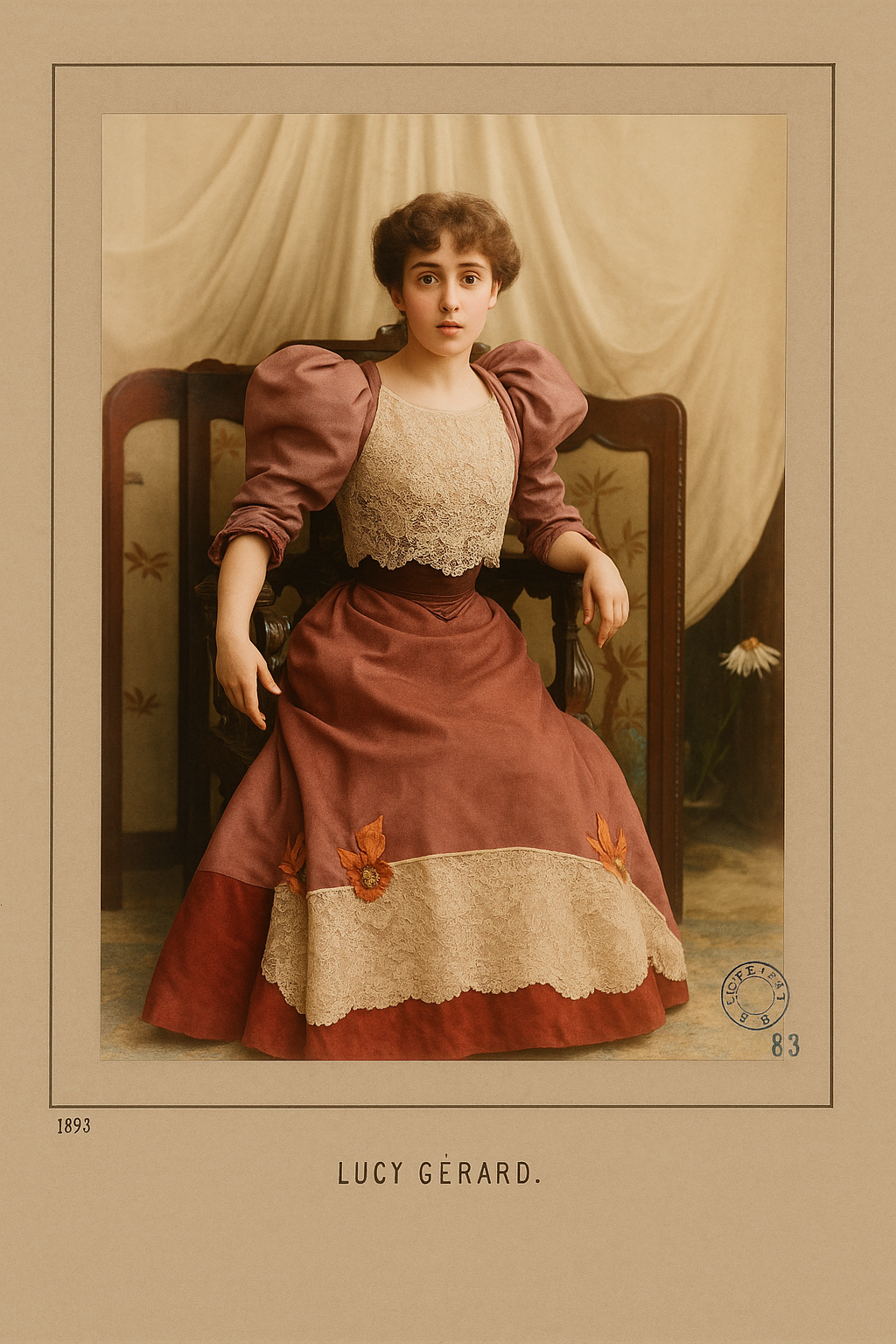
Lucy Gérard (2 June 1872 – 20 November 1941), born Marie-Louise Philiberte Lucy Gérard, was a French actress on stage and in silent films; in her later career she was billed as Lucy Mareil.


não gostei não demonstrou a pessoa imagem inespressiva feita pelo chat gpt


Lucy Gérard (2 June 1872 – 20 November 1941), born Marie-Louise Philiberte Lucy Gérard, was a French actress on stage and in silent films; in her later career she was billed as Lucy Mareil.


Early life

Lucy Gérard was born in Lyon, France, on 2 June 1872. She studied with François Jules Edmond Got at the Paris Conservatoire.[1]
Career
Lucy Gérard (c. 1890), pastel portrait by Giovanni Boldini
Geneviève Lantelme, Delphine Renot and Lucy Gérard, in Trait d'Union (1906)

Gérard began acting in her teens, with her Paris debut in 1888, in the opera Isoline. She was active on the Paris stage,[2] including a role in La Montagne Enchantée (1897) with Jane Hading.[3] She was a popular subject of souvenir postcards, cigarette cards,[4][5] and cabinet cards, and Italian artist Giovanni Boldini made a pastel portrait of her.[6]

As "Lucy Mareil", she appeared in at least a dozen French silent films, including Blessure d'amour (1916), C'est pour les orphelins! (1917), Les leçons de chant de Rigadin (1918), Madame et son filleul (1919), Chouquette et son as (1919), Les cinqs gentlemen maudits (1920), L'empereur des pauvres (1921), La flamme (1922), and Petit Ange et son pantin (1923)


 Fonte:

página 226

https://bdh.bne.es/bnesearch/detalle/bdh0000052804
https://bdh-rd.bne.es/viewer.vm?id=0000052804 

https://gallica.bnf.fr/ark:/12148/btv1b8596921x.r=Liane%20de%20Vries?rk=128756;0# 

https://gallica.bnf.fr/ark:/12148/btv1b8596921x/f29.item.r=Liane%20de%20Vries 

https://en.wikipedia.org/wiki/Lucy_G%C3%A9rard 

Don Tiburcio de Redín. Pamplona, España, 11 de agosto de 1597-La Guaira, Venezuela, 31 de agosto de 1651

Tiburcio de Redín y Cruzat, (Pamplona, España, 11 de agosto de 1597-La Guaira, Venezuela, 31 de agosto de 1651), barón de Bigüezal, caballero de Santiago,[1]​ fue un militar y marino español del siglo XVII.


Fontes

 página 253 Cromolithogravura

https://bdh-rd.bne.es/viewer.vm?id=0000052804 

https://archive.li/SP11j 


Francisco de Argote Argote, Francisco de. ¿Montilla? (Córdoba), p. t. s. XVI – Córdoba, 1604-1616. Juez de bienes confiscados de la Santa Inquisición de Córdoba. bibliófilo

 Juez de bienes confiscados de la Santa Inquisición de Córdoba.

Hijo de un segundo matrimonio de Alonso Fernández de Argote, veinticuatro de Córdoba, con Leonor de Angulo y Aranda. Nació probablemente en Montilla (Córdoba), de donde fue alcalde su abuelo materno, Alonso de Aranda. Varias noticias legales sobre un pleito por herencia contra su hermanastro Alonso, hijo del primer matrimonio de su padre, cuya primera instancia se remontaría a 1522, indican que era menor de edad en 1533, por lo que se puede fijar su fecha de nacimiento en la segunda década del siglo XVI.

Francisco de Argote no heredó el mayorazgo de su padre ni la veinticuatría. Vivió en Montilla hasta 1557, fecha en que, tras recibir una donación con parte de los bienes de su madre y de su tía materna, contrajo matrimonio con Leonor de Góngora y fijó su residencia en Córdoba. De esa unión nacieron los siguientes hijos: Francisca, Luis, Alonso, María y Juan.

El 26 de mayo de 1561 se emite una cédula real firmada por Juan Vázquez de Molina, secretario de Felipe II, que le ordena ir a Madrid como juez de residencia. El 11 de junio de ese mismo año jura el cargo de corregidor de Madrid. Justo un mes después, el 11 de julio de 1561, nace su hijo Luis. En 1563, dos cédulas reales firmadas por Francisco de Eraso, secretario de Felipe II, lo nombran juez de residencia en Andújar y Jaén. En un documento del 16 de octubre de 1576 y en numerosos testimonios posteriores es citado como juez de los bienes confiscados en el Oficio de la Santa Inquisición de Córdoba, cargo que ocupará hasta su muerte. En 1580, es nombrado caballero veinticuatro de la Ciudad de Córdoba, por renuncia voluntaria de Gonzalo de Saavedra, uno de sus yernos. El 2 de enero de 1604 escribe su testamento.

Se desconoce la fecha exacta de su muerte; sólo se sabe con seguridad que había fallecido antes del 18 de febrero de 1616, pues ésa es la fecha del testamento de su hijo Juan, quien lo menciona como difunto.

Licenciado en Cánones por la Universidad de Salamanca, se relacionó muy pronto con eruditos cordobeses del siglo XVI, como su amigo Ambrosio de Morales, quien lo elogia en su Crónica general, y Juan Ginés de Sepúlveda, con quien mantuvo una correspondencia en latín en torno a 1552. Los círculos intelectuales de su ciudad dejaron encomiásticos testimonios de la nutrida y valiosa biblioteca de este humanista y bibliófilo del siglo XVI, padre de Luis de Góngora y Argote.


https://historia-hispanica.rah.es/biografias/4379-francisco-de-argote 


Luis de Góngora y Argote. Córdoba, 11 de julio de 1561-Córdoba, ✞ 23 de mayo de 1627, Capellán real | Escritor, ra | Poeta, tisa | Sacerdote o presbítero


Luis de Góngora y Argote (Córdoba, 11 de julio de 1561-Córdoba, 23 de mayo de 1627)[1]​ fue un poeta y dramaturgo español del Siglo de Oro, máximo exponente de la corriente literaria conocida más tarde como culteranismo o gongorismo.
.Filho de
Francisco de Argote Y Aranda e 
Leonor de Góngora y Falces 


https://es.wikipedia.org/wiki/Luis_de_G%C3%B3ngora 

https://archive.li/dkcbD 

https://historia-hispanica.rah.es/biografias/4379-francisco-de-argote 

CRHOMOLITOGRAVURA PÁGINA 255

Luis de Góngora Poeta cordobés Velasquez Museo Nacional 

https://bdh-rd.bne.es/viewer.vm?id=0000052804 


Miguel Primo de Rivera y Orbaneja, 2º Marquês de Estella Jerez de la Frontera, 8 de janeiro de 1870 – Paris, 16 de março de 1930

Miguel Primo de Rivera y Orbaneja (Jerez de la Frontera, 8 de enero de 1870-París, 16 de marzo de 1930) fue un militar español que gobernó como dictador entre 1923 y 1930. Asimismo, durante ese período llegó a ostentar los cargos de Alto comisario de España en Marruecos y ministro de Estado.[1]​ 


Miguel Primo de Rivera y Orbaneja, 2º Marquês de Estella (Jerez de la Frontera, 8 de janeiro de 1870 – Paris, 16 de março de 1930) foi um militar e ditador espanhol, fundador da organização União Patriótica. Era detentor do título nobiliárquico de Marquês de Estella e de Ajdir. 


Fonte: Cromolitogravura em

 https://es.wikipedia.org/wiki/Miguel_Primo_de_Rivera 

https://bdh-rd.bne.es/viewer.vm?id=0000052804 

sexta-feira, 27 de junho de 2025

Ivone Daumerie Ramos/O grupo das lindas tocadoras do chá de beneficencia, do qual! Yvonne Daumerie é a figura central. Yvonne Stumpe Daumerie , Bahia, 1900? ✞ 3 de janeiro de 1977 no Rio de Janeiro


O grupo das lindas tocadoras do chá de beneficencia, do qual! Yvonne Daumerie  é a figura central.

aleceu em 3 de janeiro de 1977 no Rio de Janeiro. filha Janine 


foi casada com o produtor cinematográfico Alípio Ramos (1908-1973 ).

Yvonne Kuhnert Daumerie (Bahia, ? - Rio de Janeiro, 1977).

Era membro de uma família de comerciantes importadores/exportadores baianos que se transferiram para São Paulo no início do século XX. Entre 1910 e 1919 o nome de sua avó, Jeanne Daumerie, aparece como dona de uma loja de roupas femininas na cidade. Seus pais foram Eduardo Stumpe e Jeanne Kuhrnet Stumpe.

Eduardo Stumpe Alemão. (nas Buscas dá que é uma familia da Holanda, ou proximidades remontando a família ao Norte da França).

Eduardo Stumpe, alemão, e responsável pelos fretes, passagens e outras informações a respeito do paquete francês. Inexplicavelmente, no alentado e assaz. 


Page 120 Stumpe & Studer, Tobacco.

Page 122 Oils and Beaxs. Stumpe & Studer, Bahia. 

Page 172 Antonio Jose Scares, E. do Rio de Janeiro. Stumpe & Studer, Bahia. 

Page 175 Senador Baptista de Mello, Minas Geraes. Stumpe & Studer, Bahia

 https://archive.org/details/brazilatlovisian00brazrich/page/174/mode/2up?q=+Stumpe

https://econtents.bc.unicamp.br/inpec/index.php/rhac/article/download/17282/12239/45793

 O Arlequim : Revista de atualidades, n. 01, 10 nov. 1927
Publisher:     São Paulo : Typ. Irmãos Ferraz

https://digital.bbm.usp.br/handle/bbm/6542

https://digital.bbm.usp.br/handle/bbm-ext/2857?locale=en 

https://econtents.bc.unicamp.br/inpec/index.php/rhac/article/download/17282/12239/45793 

Antonio Dalmau Ex-Libris Antonio Dalmau i Jambrú. 1874 ✞ 1954.


Antoni Dalmau I Jambrú por Rossell
https://bdh-rd.bne.es/viewer.vm?id=0000204263
https://bdh-rd.bne.es/viewer.vm?id=0000204263 


Antonio Dalmau Jambrú : Ex-libris - datos.bne.es


datos.bne.es
https://datos.bne.es › resource
· Traduzir esta página
Título, Antonio Dalmau Jambrú ;: Ex-libris ;J. Llongveras ;. Lugar de publicación, [S. l. Editorial, s.n.. Fecha de publicación, entre 1900 y 1950?]
 
https://bdh.bne.es/bnesearch/detalle/bdh0000204263
Antonio Dalmau Jambrú : Ex-libris - datos.bne.es

datos.bne.es
https://datos.bne.es › resource
· Traduzir esta página
Título, Antonio Dalmau Jambrú ;: Ex-libris ;J. Llongveras ;. Lugar de publicación, [S. l. Editorial, s.n.. Fecha de publicación, entre 1900 y 1950?]
[Ex libris Antonio Dalmau i Jambrú] / 19RL22 [monograma]
Autor
Langbein, Robert (1864-1932)
Fecha
1922
Tipo de Documento
Dibujos, grabados y fotografías
Materia
Dalmau i Jambrú, Antoni (1874 - 1954)
Don Quijote (Personaje de ficción)
Panza, Sancho (Personaje de ficción)
Exlibris cervantinos
Aguafuertes - España - S.XX
Descripción física
1 estampa : aguafuerte; huella de la plancha 135 x 84 mm, en h. de 177 x 130 mm
Signatura
EXLIBRIS/706/44
CERV.SEDÓC/134/158
PID
bdh0000204250
Resumen
Don Quijote caido por tierra lanzado por el molino de viento; Sancho y el asno le miran; Rocinante huye; en la remarca, hombres que se pelean y un perro que ataca
Descripción y notas
450, muestra internacional de exlibris cervantinos, 1998 p. 72.  


St Rupertus, 660, ✞ 27 March 710 Salzburg, Duchy of Bavaria


 https://www.digitale-sammlungen.de/de/view/bsb11119994?page=540,


 https://en-m-wikipedia-org.translate.goog/wiki/Rupert_of_Salzburg?_x_tr_sl=en&_x_tr_tl=pt&_x_tr_hl=pt&_x_tr_pto=tc

Rupert of Salzburg (German: Ruprecht,[a] Latin: Robertus, Rupertus; c. 660[b] – 710 AD) was Bishop of Worms as well as the first Bishop of Salzburg and abbot of St. Peter's Abbey in Salzburg. He was a contemporary of the Frankish king Childebert III.[2] Rupert is venerated as a saint in the Roman Catholic and Eastern Orthodox churches.[3] Rupert is also patron saint of the Austrian state of Salzburg.
Rupert of Salzburg
Saint Rupert depicted with a barrel of salt in his hand
Bishop
Born
    660
Died
    27 March 710
Salzburg, Duchy of Bavaria
Venerated in
    Roman Catholic Church
Eastern Orthodox Church
Feast
    24 September [1]
27 March
Attributes
    Holding a container of salt; wearing clerical clothes including mitre; holding a crosier
Patronage
    Salzburg, The State of Salzburg, Austria, salt miners
Contents

Life

Holy tradition states that Rupert was a scion of the Frankish royal Merovingian dynasty;[3] he was possibly related to the Robertians, and likely a descendant of Count palatine Chrodbert II.
Baptism of Duke Theodo by Bishop Rupert, Franciscus de Neve (II) (c. 1670).

In his missionary work in Germany Rupert was accompanied by Saints Chuniald and Gislar, but no records of their acts have survived.[4] As bishop at Worms, Rupert was first accepted as a wise and devout dignitary, but the mostly pagan community came to reject him and forced him out of the city by the end of the 7th century. The Agilolfing duke Theodo of Bavaria requested that he come to his residence at Regensburg (Ratisbon) to help spread the Christian faith among the Bavarian tribes.

Rupert then moved to Altötting, where he started his missionary work by preaching to the locals. He would sail down the Danube river, visiting many towns, villages and forts. Soon he had converted a large population along the Danube, reaching southeastward to the Bavarian border with the Pannonian lands, which were under the rule of the Avar Khaganate. Here, he stayed at Lorch, the former Roman city of Lauriacum (today part of Enns), where an early Christian church—the present Basilica of St. Lawrence—already existed.

Warlike conditions in the borderlands made him abandon plans of missionary work in the territories of the Pannonian Avars. Instead, he proceeded along the Roman road via Seekirchen to the ruined city of Juvavum, which he made his base and renamed "Salzburg" (Latin: Salisburgum).[5] As in Lorch, Rupert was able to build on early Christian traditions that were already in place. He re-established the monastic community at St. Peter's Abbey and laid the foundations of Salzburg Cathedral, which was finished by his successor Vergilius. He also founded the Benedictine nunnery of Nonnberg beneath the Festungsberg fortifications (later Hohensalzburg Fortress), where his niece Erentrude became the first abbess.

Rupert also introduced higher education and other reforms. From Duke Theodo of Bavaria his bishopric received estates around Piding and Reichenhall, where he promoted the development of the local saltworks. Rupert's mission work also spread into the Alps, where the first monastic cell (Cella Maximiliana) was founded at present-day Bischofshofen about 711.

Rupert reportedly died on Easter Sunday around 710.[6] According to other sources, he returned to his hometown of Worms, where he died in 717. His mortal remains were transferred to Salzburg Cathedral by Bishop Vergilius on 24 September 774.
Veneration

Rupert's life and mission work is documented in medieval chronicles such as the Conversio Bagoariorum et Carantanorum. In accordance with Christian tradition, St. Rupert's feast day is celebrated by the Eastern Orthodox Church on the anniversary of his death, 27 March[3] (28 March according to the Lutheran Calendar of Saints). In Austria, it is 24 September,[7] commemorating the translation of his relics to Salzburg Cathedral. Rupertitag or Rupertikirtag is also a public holiday in the state of Salzburg, associated with popular Volksfest events.

Rupert is the patron saint of the state of Salzburg, the Roman Catholic Archdiocese of Salzburg (together with his successor Vergilius), and of the adjacent Bavarian Rupertiwinkel region. He is also known as the "Apostle of the Bavarians" and is patron of several settlements, such as Sankt Ruprecht in Styria and Šentrupert in Slovenia, and of numerous church buildings.
 

quinta-feira, 26 de junho de 2025

Bibliotheca Regia Monacensis

 https://bildsuche.digitale-sammlungen.de/index.html?c=suche_sim&bandnummer=bsb00017917&pimage=00001&einzelsegment=0&l=en

 https://bildsuche.digitale-sammlungen.de/index.html?c=suche_sim&bandnummer=bsb00017917&pimage=00001&einzelsegment=0&l=en

https://daten.digitale-sammlungen.de/~db/0001/bsb00017917/images/?nav=1&seite=00001&viewmode=1 

Lucas Cranach, o Velho, foi batizado como Lucas Müller. Nasceu no ano de 1472 em Cranach atual Kronach, na Alemanha ✞ 16 de outubro de 1553 na localidade de Weimar


Lucas Cranach, o Velho, foi batizado como Lucas Müller. Nasceu no ano de 1472 em Cranach atual Kronach, na Alemanha e faleceu em 16 de outubro de 1553 na localidade de Weimar.

Foi o principal pintor da Saxônia na época, e um dos mais importante e influente artista da Alemanha do século XVI. Entre sua vasta produção de pinturas e xilogravuras, as mais importantes são retábulos e retratos de juízes e reformadores protestantes, a sua obra retrata muitas mulheres, nus femininos alongados e senhoras elegantemente vestidas, com temas relacionados a Bíblia ou mitologia. [1]

Lucas Cranach não assinou seus trabalhos com seu nome completo. Os primeiros, antes de 1504, não foram assinados; de 1504 a 1506, sua assinatura consistia de um “LC” entrelaçado; de 1506 a 1509, utilizou as iniciais separadas “LC”; de 1509 a 1514, passou a utilizar as iniciais espaçadas e seu brasão de armas aonde se destaca uma serpente alada, que se tornou sua única assinatura em 1515. Todas as obras, mesmo aquelas que foram criadas por seus assistentes passaram a utilizar esta marca, que também foi usada por seu filho Lucas Cranach, o Jovem até a morte em 1586. Esta pratica deu origem a muitos problemas de atribuição de autoria que ainda permanecem sem solução. O fato de tão poucos trabalhos conterem qualquer data complica ainda mais o estabelecimento de uma cronologia dos trabalhos de Cranach.[
https://pt.wikipedia.org/wiki/Lista_de_obras_de_arte_de_Lucas_Cranach,_o_Velho


Cranach_il_vecchio,_sant'anna_metterza,_1516_ca


 Lucas Cranach the Elder (German: Lucas Cranach der Ältere [ˈluːkas ˈkʁaːnax deːɐ̯ ˈʔɛltəʁə]; c. 1472 – 16 October 1553) was a German Renaissance painter and printmaker in woodcut and engraving. He was court painter to the Electors of Saxony for most of his career, and is known for his portraits, both of German princes and those of the leaders of the Protestant Reformation, whose cause he embraced with enthusiasm. He was a close friend of Martin Luther, and eleven portraits of that reformer by him survive. Cranach also painted religious subjects, first in the Catholic tradition, and later trying to find new ways of conveying Lutheran religious concerns in art. He continued throughout his career to paint nude subjects drawn from mythology and religion.
Lucas Cranach the Elder
Portrait by Lucas Cranach the Younger, 1550
Born
    Lucas Maler

c. 1472
Kronach, Prince-Bishopric of Bamberg, Holy Roman Empire
Died
    16 October 1553 (aged 80–81)
Weimar, Duchy of Saxony, Holy Roman Empire
Known for
    Painting
Movement
    German Renaissance
Children
    5, including Hans and Lucas
Patron(s)
    Electors of Saxony
Signature

Cranach had a large workshop and many of his works exist in different versions; his son Lucas Cranach the Younger and others continued to create versions of his father's works for decades after his death. He has been considered the most successful German artist of his time.[1]
Contents

Early and personal life
Signature of Cranach the Elder from 1508 on a winged snake with ruby ring, depicted in a 1514 portrait

He was born at Kronach in upper Franconia (now central Germany), probably in 1472. His exact date of birth is unknown. He learned the art of drawing from his father Hans Maler (his surname meaning "painter" and denoting his profession, not his ancestry, after the manner of the time and class).[2] His mother, with surname Hübner, died in 1491. Later, the name of his birthplace was used for his surname, another custom of the times. How Cranach was trained is not known, but it was probably with local south German masters, as with his contemporary Matthias Grünewald, who worked at Bamberg and Aschaffenburg (Bamberg is the capital of the diocese in which Kronach lies).[3] There are also suggestions that Cranach spent some time in Vienna around 1500.[2]

From 1504 to 1520 he lived in a house on the south west corner of the marketplace in Wittenberg.[4]

According to Gunderam (the tutor of Cranach's children), Cranach demonstrated his talents as a painter before the close of the 15th century. His work then drew the attention of Duke Frederick III, Elector of Saxony, known as Frederick the Wise, who attached Cranach to his court in 1504. The records of Wittenberg confirm Gunderam's statement to this extent: that Cranach's name appears for the first time in the public accounts on the 24 June 1504, when he drew 50 gulden for the salary of half a year, as pictor ducalis ("the duke's painter").[3] Cranach was to remain in the service of the Elector and his successors for the rest of his life, although he was able to undertake other work.[2]

Cranach married Barbara Brengbier, the daughter of a burgher of Gotha and also born there; she died at Wittenberg on 26 December 1540. Cranach later owned a house at Gotha,[3] but most likely he got to know Barbara near Wittenberg, where her family also owned a house, which later also belonged to Cranach.[2] Cranach had two sons, both artists: Hans Cranach, whose life is obscure and who died in Bologna in 1537; and Lucas Cranach the Younger, born in 1515, who died in 1586.[2] He also had three daughters. One of them was Barbara Cranach, who died in 1569, married Christian Brück (Pontanus), and was an ancestor of Johann Wolfgang von Goethe. His granddaughter married Polykarp Leyser the Elder, thus making him an ancestor of the Polykarp Leyser family of theologians.
Career
Apollo and Diana, 1530
Portrait of Martin Luther, 1529

The first evidence of Cranach's skill as an artist comes in a picture dated 1504. Early in his career he was active in several branches of his profession: sometimes a decorative painter, more frequently producing portraits and altarpieces, woodcuts, engravings, and designing the coins for the electorate.[3]

Early in the days of his official employment he startled his master's courtiers by the realism with which he painted still life, game and antlers on the walls of the country palaces at Coburg and Locha; his pictures of deer and wild boar were considered striking, and the duke fostered his passion for this form of art by taking him out to the hunting field, where he sketched "his grace" running the stag, or Duke John sticking a boar.[3]

Before 1508 he had painted several altar-pieces for the Castle Church at Wittenberg in competition with Albrecht Dürer, Hans Burgkmair and others; the duke and his brother John were portrayed in various attitudes and a number of his best woodcuts and copper-plates were published.[3]

In 1509 Cranach went to the Netherlands, and painted the Emperor Maximilian and the boy who afterwards became Emperor Charles V. Until 1508 Cranach signed his works with his initials. In that year the elector gave him the winged snake as an emblem, or Kleinod, which superseded the initials on his pictures after that date.[3]
Portrait of Frederick III, Elector of Saxony, c. 1530–1535

Cranach was the court painter from 1505 to 1550[5] to the electors of Saxony in Wittenberg, an area in the heart of the emerging Protestant faith. His patrons were powerful supporters of Martin Luther, and Cranach used his art as a symbol of the new faith. Cranach made numerous portraits of Luther, and provided woodcut illustrations for Luther's German translation of the Bible.[6] Somewhat later the duke conferred on him the monopoly of the sale of medicines at Wittenberg, and a printer's patent with exclusive privileges as to copyright in Bibles. Cranach's presses were used by Martin Luther. His apothecary shop was open for centuries, and was only lost by fire in 1871.[3]

Cranach, like his patron, was friendly with the Protestant Reformers at a very early stage; yet it is difficult to fix the time of his first meeting with Martin Luther. The oldest reference to Cranach in Luther's correspondence dates from 1520. In a letter written from Worms in 1521, Luther calls him his "gossip", warmly alluding to his "Gevatterin", the artist's wife. Cranach first made an engraving of Luther in 1520, when Luther was an Augustinian friar; five years later, Luther renounced his religious vows, and Cranach was present as a witness at the betrothal festival of Luther and Katharina von Bora.[2] He was also godfather to their first child, Johannes "Hans" Luther, born 1526. In 1530 Luther lived at the citadel of Veste Coburg under the protection of the Duke of Saxe-Coburg and his room is preserved there along with a painting of him. The Dukes became noted collectors of Cranach's work, some of which remains in the family collection at Callenberg Castle.
Portrait of Martin Luther, 1526, The Phoebus Foundation

The death in 1525 of the Elector Frederick the Wise and Elector John's in 1532 brought no change in Cranach's position; he remained a favourite with John Frederick I, under whom he twice (1531 and 1540) filled the office of burgomaster of Wittenberg.[3] In 1547, John Frederick was taken prisoner at the Battle of Mühlberg, and Wittenberg was besieged. As Cranach wrote from his house to the grand-master Albert, Duke of Prussia at Königsberg to tell him of John Frederick's capture, he showed his attachment by saying,[3]

    I cannot conceal from your Grace that we have been robbed of our dear prince, who from his youth upwards has been a true prince to us, but God will help him out of prison, for the Kaiser is bold enough to revive the Papacy, which God will certainly not allow.[3]

Den gylne tidsalder, Gullalderen (The Golden Age), 1530, National Museum of Art, Architecture and Design
Hunting near Hartenfels castle, 1540

During the siege Charles V, the Holy Roman Emperor, remembered Cranach from his childhood and summoned him to his camp at Pistritz. Cranach came, and begged on his knees for kind treatment for Elector John Frederick.[3]

Three years afterward, when all the dignitaries of the Empire met at Augsburg to receive commands from the emperor, and Titian came at Charles's bidding to paint King Philip II of Spain, John Frederick asked Cranach to visit the city; and here for a few months he stayed in the household of the captive elector, whom he afterward accompanied home in 1552.[3]
Death and veneration

He died at age 81 on 16 October 1553, at Weimar, where the house in which he lived still stands in the marketplace.[1] He was buried in the Jacobsfriedhof in Weimar.

The Lutheran Church remembers Cranach as a great Christian on 6 April along with Dürer,[7] and possibly Grünewald or Burgkmair.[8]
Works and art
Adam and Eve, woodcut, 1509
Study for portrait of Margaret of Pomerania (1518–1569), c. 1545, a drawing with all details of the sitter's costume meticulously described, was intended for the future reference and to facilitate the work on large number of commissions in the artist's atelier.

The oldest extant picture by Cranach is the Rest of the Virgin during the Flight into Egypt, of 1504. The painting already shows remarkable skill and grace, and the pine forest in the background shows a painter familiar with the mountain scenery of Thuringia. There is more forest gloom in landscapes of a later time.[3]

Following the huge international success of Dürer's prints, other German artists, much more than Italian ones, devoted their talents to woodcuts and engravings. This accounts for the comparative unproductiveness as painters of Albrecht Dürer and Hans Holbein the Younger, and also may explain why Cranach was not especially skilled at handling colour, light, and shade. Constant attention to contour and to black and white, as an engraver, seems to have affected his sight; and he often outlined shapes in black rather than employing modelling and chiaroscuro.[3]

The largest proportion of Cranach's output is of portraits, and it is chiefly thanks to him that we know what the German Reformers and their princely adherents looked like. He painted not only Martin Luther himself but also Luther's wife, mother and father. He also depicted leading Catholics like Albert of Brandenburg, archbishop elector of Mainz, Anthony Granvelle and the Duke of Alva.[3]

A dozen likenesses of Frederick III and his brother John are dated 1532. It is characteristic of Cranach's prolific output, and a proof that he used a large workshop, that he received payment at Wittenberg in 1533 for "sixty pairs of portraits of the elector and his brother" on one day.[3] Inevitably the quality of such works is variable.
Religious subjects
Allegory of Law and Grace, c. 1529

Cranach's religious subjects reflect the development of the Protestant Reformation, and its attitudes to religious images. In his early career, he painted several Madonnas; his first woodcut (1505) represents the Virgin and three saints in prayer before a crucifix. Later on he painted the marriage of St. Catherine, a series of martyrdoms, and scenes from the Passion.[3]

After 1517 he occasionally illustrated the old subjects, but he also gave expression to some of the thoughts of the Reformers, although his portraits of reformers were more common than paintings of religious scenes. In a picture of 1518, where a dying man offers "his soul to God, his body to earth, and his worldly goods to his relations", the soul rises to meet the Trinity in heaven, and salvation is clearly shown to depend on faith and not on good works.[3]

Other works of this period deal with sin and divine grace. One shows Adam sitting between John the Baptist and a prophet at the foot of a tree. To the left God produces the tables of the law, Adam and Eve taste the forbidden fruit, the serpent raises its head, and punishment manifests in the shape of death and the realm of Satan. To the right, the Conception, Crucifixion and Resurrection symbolize redemption, and this is duly impressed on Adam by John the Baptist. There are two examples of this composition in the galleries of Gotha and Prague, both of them dated 1529.[3] His workshop made an altarpiece with a Crucifixion scene in the centre which is now in the Kreuzkirche, Hanover.

Towards the end of his life, after Luther's initial hostility to large public religious images had softened, Cranach painted a number of "Lutheran altarpieces" of the Last Supper and other subjects, in which Christ was shown in a traditional manner, including a halo, but the apostles, without halos, were portraits of leading reformers. He also produced a number of violent anti-Catholic and anti-Papacy propaganda prints in a cruder style. His best known work in this vein was a series of prints for the pamphlet Passional Christi und Antichristi,[9] where scenes from the Passion of Christ were matched by a print mocking practices of the Catholic clergy, so that Christ driving the money-changers from the Temple was matched by the Pope, or Antichrist, signing indulgences over a table spread with cash (see gallery below). Some of the prints were echoed by paintings, such as his Adoration of the Shepherds (c. 1517).

One of his last works is the altarpiece, completed after his death by Lucas Cranach the Younger in 1555, for the Stadtkirche (city church) at Weimar. The iconography is original and unusual: Christ is shown twice, to the left trampling on Death and Satan, to the right crucified, with blood flowing from the lance wound. John the Baptist points to the suffering Christ, whilst the blood-stream falls on the head of a portrait of Cranach, and Luther reads from his book the words, "The blood of Christ cleanseth from all sin."[3

https://en-m-wikipedia-org.translate.goog/wiki/Lucas_Cranach_the_Elder?_x_tr_sl=en&_x_tr_tl=pt&_x_tr_hl=pt&_x_tr_pto=tc 

https://digi.ub.uni-heidelberg.de/diglit/franck1813/0023/image,info,thumbs 


Venezia Trattato nuovo delle cose maravigliose dell'alma città di Roma. Spanish/ tÁ CERTO O NOME DO ARQUIVISTA = gUERRA DIGITAL, RS Será que o sobrenome dele é Guerra?

 RETORNAR AQUI https://rosas-dos-ventos.blogspot.com/2019/04/bibliotecas-virtuais-links-para-livros.html      https://library.nga.gov/discov...